Re-engineering the moral architecture of care.
EBVEF connects technology design, ethics, and policy. Joie Lamar’s framework asks how empathy can move from an aspiration to an actionable engineering principle, challenging design logics that privilege efficiency, control, and human-centred assumptions.
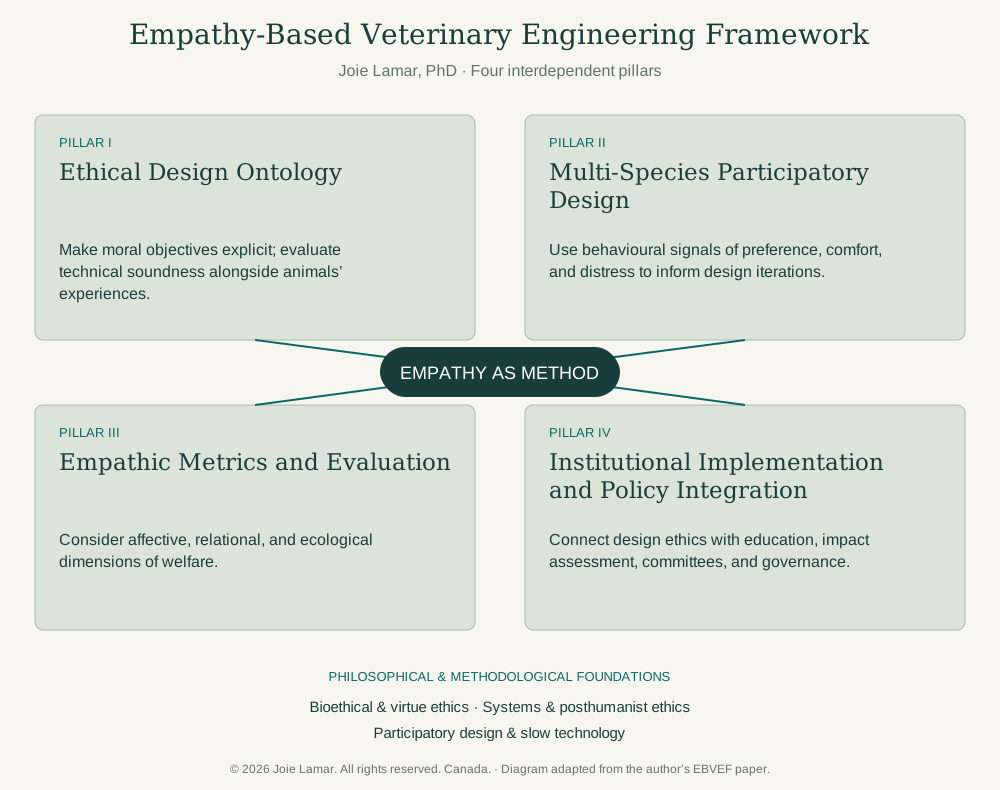
Four interdependent pillars
Ethical Design Ontology
Begin with explicit moral objectives. Evaluate prototypes and algorithms for technical soundness and their effects on animals’ experiences.
Multi-Species Participatory Design
Bring animals’ behavioural signals of preference, comfort, and distress into design feedback, interpreted with appropriate species and individual context.
Empathic Metrics and Evaluation
Consider affective, relational, and ecological domains: emotional wellbeing, human-animal interaction, and wider environmental and social effects.
Institutional Implementation and Policy Integration
Connect empathy-based innovation with education, proposed Empathy Impact Assessments, multispecies ethics committees, and governance.
Foundations
Bioethical and virtue ethics; systems and posthumanist ethics; participatory design and slow technology form the philosophical and methodological foundations described in the paper.
Read the white paper
Publication details, abstract & citation →
The download includes the full author-supplied paper, its references, a new cover, and the framework diagram. It discusses a conceptual welfare-monitoring application, implications, limitations, and future research.
Download EBVEF white paper ↓© 2026 Joie Lamar. All rights reserved. Canada. The EBVEF framework text and accompanying diagram are presented with the author’s copyright notice.